Types of interspecies interactions
Uploaded 02/06/2022


Interactions between different species are called interspecies interactions. Types of interspecies interactions can range from beneficial to detrimental for the two species involved in the exchange.
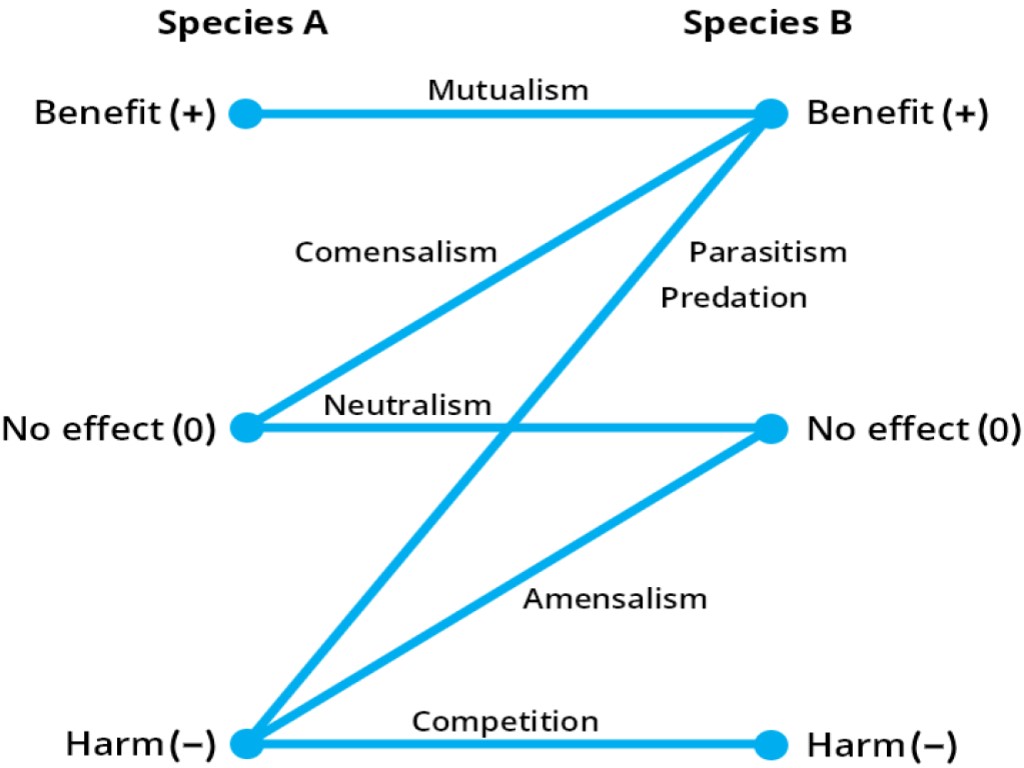
Interactions between different species are called interspecies interactions. Types of interspecies interactions can range from beneficial to detrimental for the two species involved in the exchange. The definitions outlined here are just a guide and in no way are meant to be the precise definition of each interaction type. Moreover, we are well aware that interactions between two species can sometimes be assigned to different interaction categories (Figure adapted from https://link.springer.com/chapter/10.1007/978-3-030-32394-3_14).
The most obvious interaction is when one organism (predator) consumes another (prey). Here, the predator benefits (+) from consuming the prey which is obviously negatively affected (-). In the most basic definition, predation (+/-) can be performed by an animal consuming another animal (Carnivory), an animal consuming a plant (Herbivory), or an animal consuming a fungus (Fungivory).
In parasitism (+/-), something similar happens to predation in the sense that the parasite (e.g., mosquito) benefits from consuming nutrients in detriment of its host (e.g., human). But, unlike predators which kill and eat many prey (carnivores), or graze and consume parts of many prey (herbivores) in their lifetime, parasites in general concentrate on one or just a few hosts in their lifetime (read the Ecology book from Begon et al., Chapter 8, The Nature of Predation, introduction on the subject).
In interspecific competition (-/-), both species are negatively affected. Competition in ecology can generally be defined as the direct or indirect interaction of organisms that leads to a change in fitness when the organisms share the same resource. For example, lions, leopards, and hyenas are competing for the same limited prey resources (e.g., gazelles, impalas).
On the other hand, in mutualism (+/+) both species benefit from the interaction. By definition, each species involved in a mutualism must receive a benefit from the interaction, which should outweigh the cost of giving that benefit to the other species. However, mutualist partners do not necessarily receive equal benefits or incur equal costs. Darwin acknowledged that mutualistic interactions are selfish and not altruistic since they are only preformed if the benefits outweigh the costs. He wrote in On the Origin of Species (1859), ” . . . I do not believe that any animal in the world performs an action for the exclusive good of another of a distinct species, yet each species tries to take advantage of the instincts of others . . . “. Pollination is the perfect example of mutualism where pollen is transported by animals from one plant to the other while the animals get nutrients from the plant flower. Sometimes a mutualism can convert to parasitism and vice versa. For example, oxpeckers eat the ectoparasites of big ungulates in Africa, but sometimes they also hurt the animals to drink their blood.
Finally, commensalism (+/0) and amensalism (-/0) are interactions where only one species is affected. In commensalism one individual benefits while the other is neither helped nor harmed. For example, epiphytes found in tropical rainforests grow on the branches of trees in order to access light, but the presence of the epiphytes does not seem to affect the trees. Sometimes a mutualistic or parasitic interaction can be confused for a commensal one because of lack of information on the interaction. In amensalism, one species is negatively affected while the other is not. For example, when ungulates are present, some insects are negatively affected since they have less food to eat, but the presence of those insects do not affect significantly the ungulates.
Types of interspecies interactions
For more detail information check interspecies interactions definitions. You can also find examples of all the interactions at speciesconnect.com by searching for Cases, Interactions or Species and filtering for the different type of interactions.