The hidden world of underground fungi networks
Uploaded 04/30/2025


Scientists map fungi networks underground to protect biodiversity and fight climate change. These hidden organisms form vital partnerships with plants and trees worldwide.
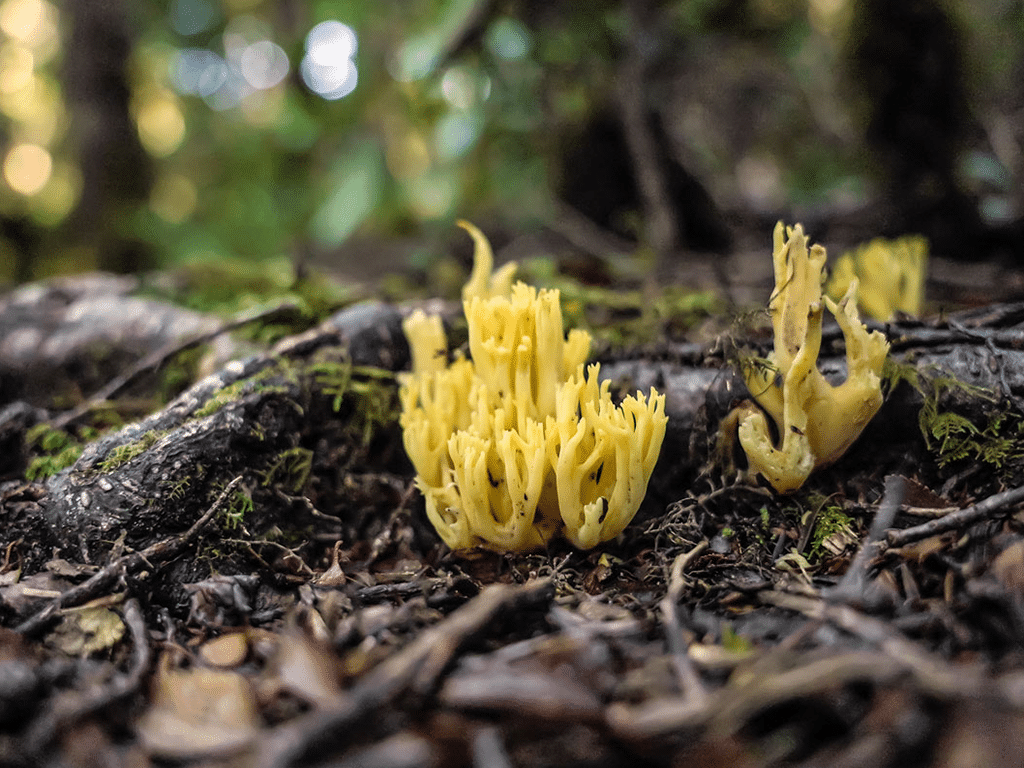
Fungi networks. Beneath our feet lies a vast, interconnected world that few ever see—a complex web of fungal networks essential to life on Earth. Scientists are now racing to map these underground systems, uncovering their secrets to protect biodiversity and combat climate change.
In Chile’s Villarrica National Park, a team of researchers recently trekked through dense forests and volcanic slopes, collecting soil samples rich with mycorrhizal fungi. These tiny organisms form symbiotic relationships with plant roots, exchanging nutrients for carbon in a partnership that dates back hundreds of millions of years. The expedition, led by the Society for the Protection of Underground Networks (SPUN), is part of a global effort to document fungal diversity before human activity disrupts these delicate systems irreversibly.
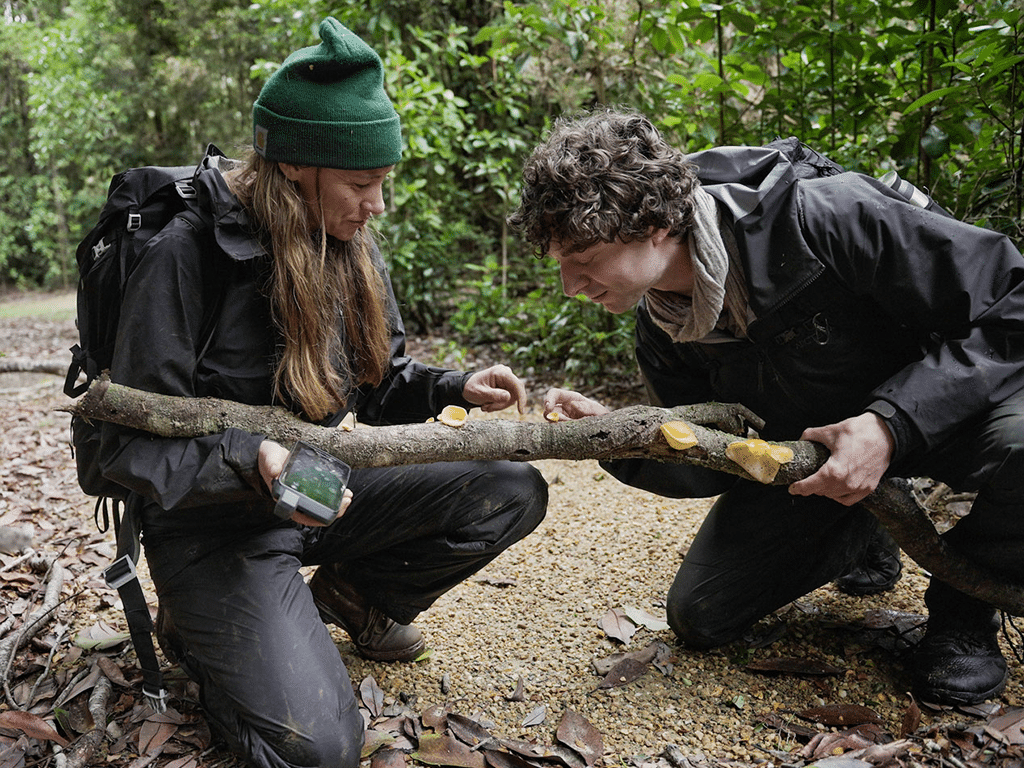
Mycologists Toby Kiers (left) and Merlin Sheldrake examine fungi growing on wood in Chile’s Valdivia National.
Why Fungi Matter
Fungi are the unsung heroes of ecosystems. Unlike plants, they don’t photosynthesize, and unlike animals, they don’t move—yet they sustain nearly all terrestrial life. Mycorrhizal fungi, in particular, act as underground highways, shuttling water and nutrients between plants while storing vast amounts of carbon. Some species even help trees communicate, passing chemical warnings about pests or drought through their intricate mycelial networks.
Despite their importance, fungi have been largely ignored in conservation. Fewer than 600 fungal species have been assessed for extinction risk, compared to tens of thousands of plants and animals. SPUN’s mission is to change that by creating the first global map of mycorrhizal fungi, identifying hotspots of fungal diversity that need protection.
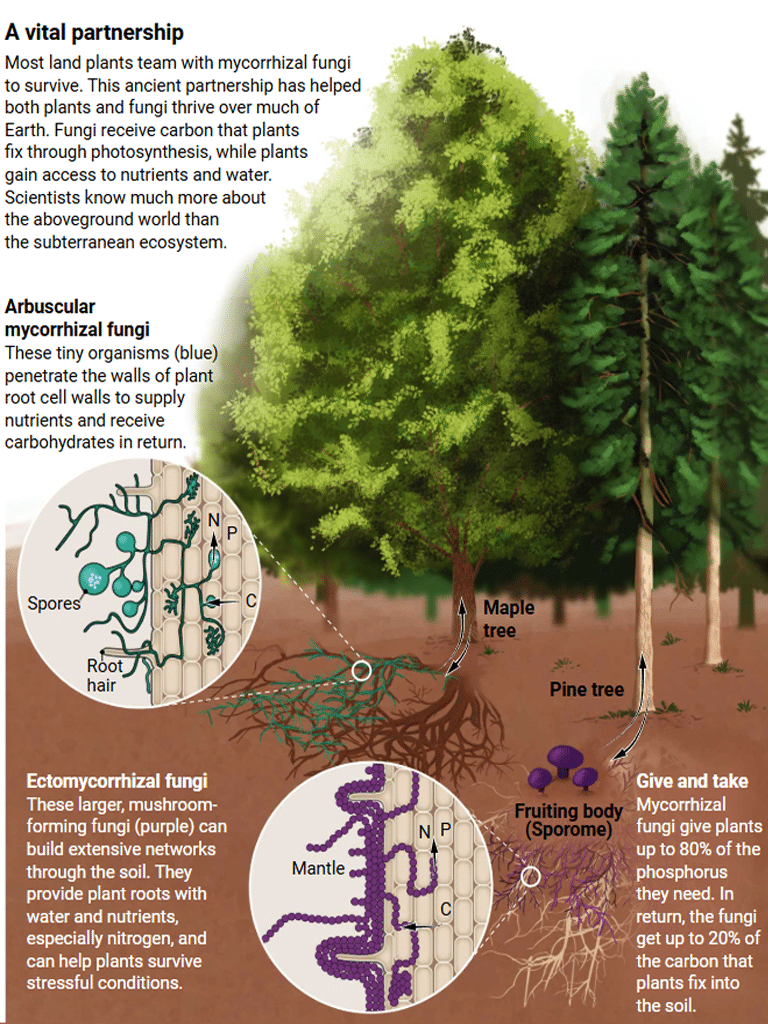
Illustration of fungal networks connecting trees in a forest, showing nutrient exchange
Technology Meets Fieldwork
To locate these hidden networks, SPUN combines cutting-edge machine learning with old-fashioned fieldwork. Algorithms analyse environmental data—like soil type, climate, and vegetation—to predict where undiscovered fungi might thrive. Then, teams of “myconauts” venture into remote areas to collect soil samples, which are later analysed for DNA.
In Chile, the team focused on ancient forests dominated by Araucaria trees, whose roots may host unique fungal communities. They also sampled eucalyptus plantations, where invasive Australian fungi might have hitchhiked with the trees. Comparing these ecosystems helps scientists understand how human activity alters underground biodiversity.

Computer modeling helps SPUN researchers identify promising sampling locations. They use GPS units to find sampling sites and record coordinates on soil sample bags to ensure the data will improve future models
A New Era for Fungal Conservation
The findings could revolutionize how we protect ecosystems. Traditional conservation often focuses on charismatic species like tigers or orchids, but SPUN argues that saving fungi is just as crucial. Their work has already inspired policy changes—Chile, thanks to advocacy by mycologist Giuliana Furci, became the first country to legally protect fungi nationwide.
Other nations are following suit. The International Union for Conservation of Nature (IUCN) recently called for fungi to receive the same attention as plants and animals, and the UN now includes fungi in its soil biodiversity initiatives. SPUN’s maps will guide these efforts, ensuring that conservation plans account for life both above and below ground.
The Road Ahead
SPUN’s next expeditions will target fungal hotspots in Mongolia’s steppes and the Congo Basin’s lowlands. Each sample adds to a growing database that could one day predict how fungi will respond to climate change—or even help farmers grow crops with fewer fertilizers by harnessing natural fungal partnerships.
For now, the message is clear: the fate of forests, farms, and the climate is intertwined with the fate of fungi. By bringing these hidden networks into the light, scientists hope to secure a healthier future for the planet—one thread of mycelium at a time.